Sunday, 19 May 2019

In the world kitchen! A wee tipple Sri Lankan style!


Image result for sri lanka flag


Although the Ceylon Lion seems to be a emblem of Sri Lanka, it has been extinct since 37,000 Bc.

This 'King of the Savannah' symbolises visionary leadership and power; and not only dominates the Sri Lankan flag and lends its name to Sigiriya, the ancient rock fortress near Dambulla but is also the trademark for Sri Lankan lager.

Lion lager

With 4.8% alcohol volume this lager is credited as a great thirst quencher. Golden malt in colour, it is sweet with a hint of fruit flavour. The black and gold label shows a strong and watchful golden lion.
A nice drop!

                                     Image result for lion beer


Ceylon Arrrack

Arrack is a traditional Sri Lankan spirit distilled from the sap of the coconut flower and aged in oak casks. This golden coloured toddy tastes like something between whisky and rum, and is most definitely an acquired taste. However, used as a cocktail base, arrack can be quite sensuous.


Image result for arrack


Coconut water.

Time for a little hydration after giving your liver a workout! Coconut water, Sri Lankan super food is known to refresh and pep you up in a tropical climate. Best taken fresh from the source!


Ceylon tea

This aromatic, refreshing tea not only tastes great but is considered one of the best teas world wide. It boasts many health benefits; promotes cardiovascular health, aides immunity and provides energy just to name a few.

Image may contain: one or more people, plant, grass, outdoor and nature


Image may contain: coffee cup and drink


                Saudiyapuramu!                       


Friday, 10 May 2019

Sri Lanka: Jaffna and Trincomalee!

Jaffna.


The humidity’s ethereal fingers encompassed us as we await on Anuradhapura station to travel north to Jaffna.  It is in Jaffna, that the Liberation Tigers Tamil Eelan (LTTE) embarked on a 30-year violent struggle with the Sri Lankan military for the establishment of a separate homeland in the North.  Over 75,000 people died during the conflict and over 1,000,000 land mines still lace the ground.  Our journey North took around four hours on the local train, and as we watched out the window, the toll of the war was still apparent.  Abandoned homes, derelict farms and destroyed infrastructure litter the landscape, we later learnt that 16 of the 19 military battalions are still stationed in the North and that people are slowly returning to their homeland.

Our ferry, to Nainativu Island, the Northern most point in Sri Lanka, was simply a converted wooden fishing boat, (aka people smuggler limousine). As our boat neared the Island, we were greeted with the first glimpse of Nainativu Nagapooshani Amman Temple.  This ancient and historic Hindu temple is dedicated to Parvati and is a significant symbol for the Tamil people. It houses four gopurams (gateway towers) ranging from 20–25 feet in height, to a soaring at 108 feet.

Image may contain: 1 person        Image may contain: people standing, sky and outdoor         

Jaffna also houses the famous Dutch Fort which is a legacy of the country’s colonial past and maritime heritage. The Portuguese built the fort in 1618 and was re-built by Dutch colonisers who took over the Fort in 1680.  The Fort is all but ruins but provides a spectacular viewpoint from the rampart to watch the sunset over the Indian Ocean.

Image may contain: outdoor        Image may contain: outdoor and nature        Image may contain: outdoor and water

Back on the mainland we visited a local family for a cooking demonstration followed by a delightful dinner of traditional cuisine.


Local bus on to Trincomalee.

An hour on this bus was quite sufficient to get the drift of public transport in Sri Lanka. The aircon consisted of open windows to allow the local transport fumes to congest our lungs as the Sri Lankan 'top of the pops' blared at full volume. We stopped at the various stations, more people boarded and eventually it was standing room only. The ticket master made his way through the crowd after every stop to ensure all had paid their way. A tad worried when the time to disembark but although it looked quite chaotic, all went smooth and we made it in one piece.

Image may contain: sky and outdoor                                                    

Trincomalee is a port city on the northeast coast of Sri Lanka. A popular holiday destination for both tourist and local alike. We had some free time here with sea side options available. We choose snorkling and a lovely couple of hours were spent out on the reef. The underwater garden was lovely although bias as we are; not as gorgeous as our own Barrier reef. Our free afternoon was spent wallowing in the sea without a stinger in sight, bliss!

 Image may contain: one or more people, sky, outdoor and nature


Friday, 3 May 2019

In the world kitchen! Sri Lanka!

 The pearl of the Indian Ocean, Sri Lanka!
Making liberal use of local fruit, seafood and an arsenal of spices, Sri Lankan cuisine delivers much more than just curry and rice. 
Here are some temptations not to be missed:

Appam 
A type of pancake made with fermented rice batter and coconut milk. A ladle of batter is fried in a small wok and swirled around to create a small bowl. You can top these little delights with a variety of concoctions; sweet or savoury! Try the traditional banana with grated coconut and palm sugar or for the more daring; coconut chutney, shallots and chilli. Eat for Breakfast, lunch or dinner, no set rules, just use your imagination!
                                        

Kottu
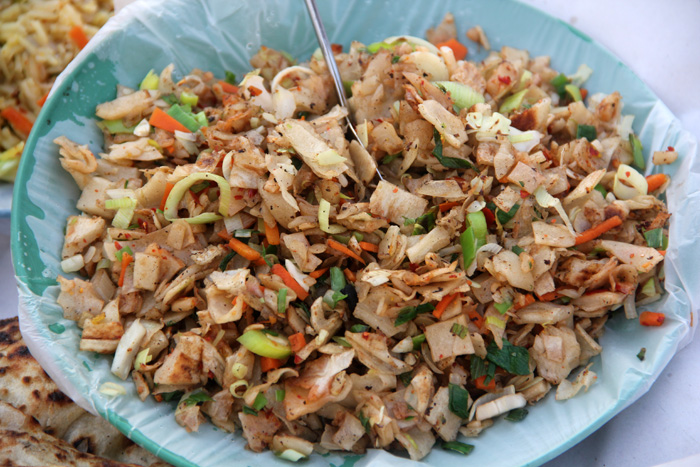
This simple but tasty dish uses godamba roti as its core. A combination of vegetables & fragrant spices are stir fried until almost tender, add in a beaten egg then the shredded roti for a couple of minutes before serving. Yet again, a versatile dish; vegetarian or add meat or seafood. Delicious!
Vegetable Kottu - Sri Lanka

Fried salted fish
 Our guide Yasi took us for culinary experience in a village; here the local women cooked up the most divine banquet. A delectable array of curries and other traditional tit bits were served but the piece de resistance was the salted, fried fish!
Image may contain: food

Image may contain: 1 person, smiling, sitting, food and indoor

Image may contain: food

No photo description available.

Godaak rasai bohoma sthuthi!


Friday, 26 April 2019

Sri Lanka: Negombo & Anuradhapura!

 First stop, Negombo.

A lovely little seaside town to start our sojourn. We were accommodated in the Rani beach resort, strolled along the beach, enjoyed cocktails by the pool and just relaxed before the tour began. Dinner was on the beach with the promise of a fire show. Yipee! Much to our amusement, the fire show turned our to be nothing but a bon fire. Ha ha

Blood red was the sun as it cascaded across Negombo fish market, spot lighting  the creatures spewed from the depths of the ocean.  The ground turned crimson to match the awakening sun as fish innards splattered like a monsoonal storm and scales become adrift, falling like dandruff.  Crows feasted on the waste scattered by the cacophony of fisherman who bantered and shared tales of conquests, whilst dogs salivated and guarded this carnage. This market is a vegan’s worst nightmare.  The obnoxious odour burns into pores and penetrates the senses; the sounds of auctioneers screaming mixes with machetes cutting and gorging through flesh causing a tsunami of goosebumps.  A must-see incubus!

Tuk tuk negotiations took us to the esplanade where fisherman mending nets and boats await the call of the sea.  The dry fish market sweeps across the sun-baked foreshore. The men gut and scale the catch of the day whilst the women tend to the drying process, rotating, stacking and sorting of the mummified fish. 


Onward to Anuradhapura World Heritage site.

We donned our bicycle helmets (decided against the lycra accompaniment) and hit the bitumen in the sacred city of Anuradhapura.  This city froths around Buddha and the Bodhi sapling that was transported here in the 3rd century by Sanghamitta. 

We explored ancient ruins that spilt forth huge bell shaped Stupas, ponds and palaces. We felt the second of Buddha’s Noble Truths (we are born to suffer), as we walked on stoneware that resembles the hot coals of fire walkers. With piston liked legs, we pummelled our way towards Ruwanwelisay and Mirisawetiya Stupas, built like all good monuments to celebrate the blood shed of victory at war by King Dutugamunu between 140 – 160 BC and which hold relics associated with Buddha.

Our legs became torpid, as the sun began to bleed dry, we came to a halt in front of what was once the largest Stupa in the world at 122m high and the 3rd largest structure in the ancient world – Jetauanaramaya.  Entombed inside the Stupa is a sash once tied by Buddah).  Finally, we sat and watched the sunset dance across Thissa Wewa reservoir as local families wash and skylark in its water.   

 Bohoma sthuthi for this amazing start to our adventure.


                                     Image may contain: sky, ocean, outdoor, nature and water


Thursday, 7 March 2019

Happy Hammams!


Evolving from the Ottoman Empire, the hammam is the social hub of Moroccan daily life. Baths are separated by gender and locals are known to spend hours there gossiping with friends.

When visiting a foreign country, we always try to embrace the culture as much as possible and luckily in today's tourist world, a method of luxurious cleansing and relaxation was on offer.  Thus, we decided to let our inhibitions run wild and booked in. Our fearless guide Fouad recommended 'the 5 elements'; so we wound our way through a Medina in Marrakesh to a beautiful, white washed, building with magnificent archways.

Directed to change into hooded, fluffy, white gowns, and then led to the steam room,  we sat and sweated  in a temperature of a volcano's core. Moving on to the cleansing room, we lay (in only our undies) like slabs of salmon on  marble benches. Our attendants chatted and giggled as they put us through our paces. They  lathered our bodies with a brown mud like mix and proceeded to exfoliate with loofah mitts. A great source of amusement came when they showed us the enormous amount of dead skin removed.

After showering and another sauna, we were ushered to the next station. The massage! The masseuses were very thorough,  they honed in and concentrated on our weak spots and left us feeling very supple and relaxed. Still it was not over, we lounged on day beds, drank mint tea and reflected on how marvellous life is!


                                Image result for five elements hammam in Marrakech

Image result for 5 elements spa in Marrakech


Image result for 5 elements spa in Marrakech


Sunday, 3 March 2019

Wanderings through Morocco 2

Our sojourn finally took us away from the urban sprawl of industrial cities and the people smugglers of Tangier, to the fabled Atlas mountains.  These snow-capped peaks jutted upwards framed by arid valleys and mud brick Berber villages; a much needed respite from the frantic streets of Casablanca, Fez, and Marrakech.

It is at the village of Imlil that we placed our overnight gear on to a pack-mule, slapped on our hiking gear and embarked on an exploration, first to Aroumd - a traditional mountain village perched on a rocky outcrop that provides breath-taking views of the High Atlas Mountains and then later on to Sidi Chamharouch - the White Shrine.  This ramble took us across rock strewn flood plains to a track etched into a mountainside, and like goats in an Argon tree, we climbed upwards.

As our senses captured the beauty surrounding us, our paths crossed with fellow hikers, waving freedom flags - The Berber national flag that signifies an affinity with the sea (blue), the mountains (green), the desert (yellow) and the 'Yaz', the free man.

Late afternoon, as the temperature plummeted, we greeted the White Shine of Sidi Chamharouch, which sits overlooking a cascading waterfall.  It is here that the disenfranchised and disillusioned pilgrim trek, seeking guidance from Allah to overcome their malaise.  Sacrifices occur and offerings of goats and chickens are given to the local village members by those afflicted with this angst.  Here they will stay until their thoughts clear and a positive disposition fills them. After making our way back down to Imlil, we spent the  evening  with a traditional Berber family, enjoying a delicious meal and homely hospitality.

New Year Eve sees us on the move to the fringe of the Sahara.  Our ears popped as we wound our way through Tizi n'Tichka, Morocco's highest pass at 2260m to Ait Benhaddou.   One of Morocco's iconic sites and a tourist mecca for those wanting to glimpse scenery from Gladiator and Games of Thrones; this world heritage listed, fortified village is a great example of clay architecture and home to a mere six families.  As night descended, Moroccan wine flowed,we joined hands as our strangled verses of Auld Lang Syne floated ethereal like towards the fabled  city.

From the fringe of the Sahara, we were thrown body first into its mouth; where ochre sands swarmed over us, like waves crashing across a shore-line.  After a bumpy four wheel drive ride, we straddled Sydney and Thomas, our camels, for a ride out to the apex of sand dunes - standing 150m in height. This towering Goliath engulfed us in a sense of solitude as our virgin footprints tattooed the sand.  Sand boards materialised and the mighty dune was conquered as the final rays of the sun kissed us good night. After a another superb meal of traditional Berber fare,  a roaring fireplace beckoned, stories were shared, wine consumed, the night stars burn't so brightly that their number and intensity overwhelmed. The true beauty of silence was realised.  The magic of the mighty Sahara remains lovingly etched in our memories.

Our travels take us from the arid desert of the Sahara to the salt spray of Essaouria.  Here restaurateurs haggled over the days catch from fisherman, whose faces were etched with stories from the sea, shoe-shine artist and beggars all hawk for the tourist dollars.  Western music beckoned from cafes which seem to erode ever so slightly, the veil of conservative Islam. 

 To Morocco and Fouad (our fabulous guide), we say a huge Shukran!


 'We think this may be the beginning of a beautiful friendship'


Friday, 1 February 2019

Monsoonal Rain!

Drop by drop the heavens cry,
with the breath of sweet rain.
Leaves rejoice in delicious favour.
Dams; thirst quenched start to fill
and barren lands do flourish.

Gumboots squawk and splash,
as brightly coloured umbrellas dance.
Wipers move erratically,
 clearing the line of vision.
Condensation and mould take grip,
as the monsoon refuses to cease.

 A never ending pelting soaks the earth,
the terra firma becomes fickle.
 Sodden soil loses strength,
 the shift in nature unwelcome.
Trees move and  the ground quakes,
staunchly hoping to keep its place.

As the deluge perseveres,
havoc does reek.
Flooding, landslides
 and crops falter.
An infliction to life and property!

Send the Ark!